
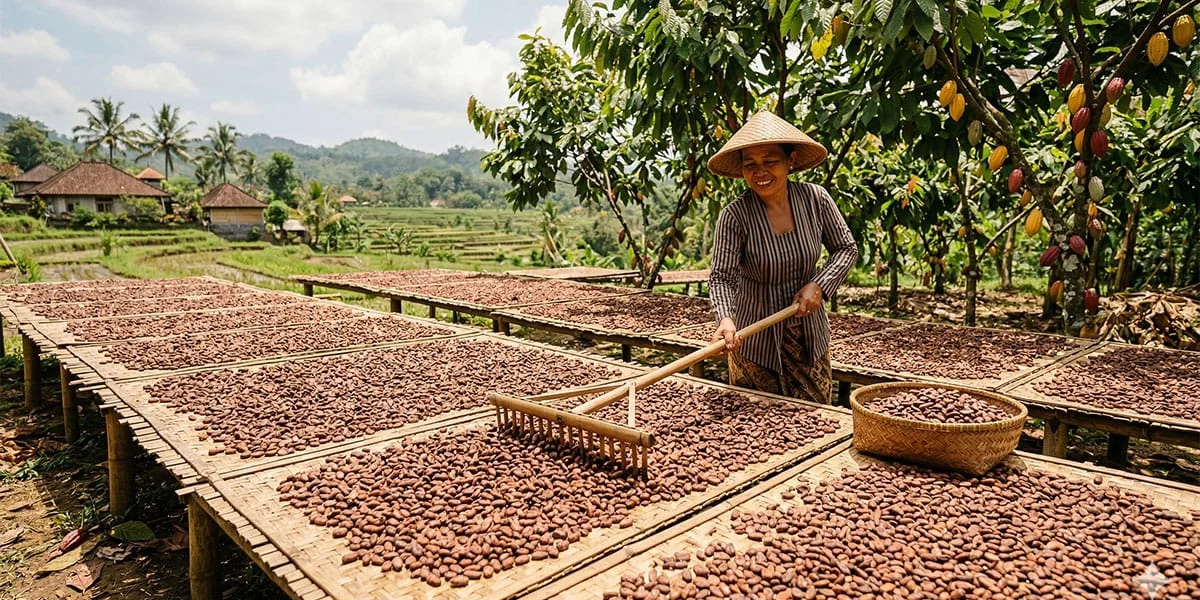
Uncovering the Development of Cacao Farming in Indonesia:
From Quantity to Premium Quality
Indonesia has long made a name for itself as one of the world’s giant producers of cacao beans. The vast expanse of cacao plantations stretching from Sumatra to Papua has sustained millions of farmers for decades. However, did you know that the face of the archipelago’s cacao industry is currently undergoing an extraordinary transformation?
The development of cacao farming in Indonesia is no longer just about “how many” beans can be harvested, but rather “how good” the flavor quality can be. Let’s trace the long journey of this golden chocolate commodity, from the past to future trends.
The Past: Triumphant in Quantity, Constrained by Quality
From the 1980s to the early 2000s, Indonesia enjoyed its golden age, ranking among the top three largest cacao exporting countries in the world. The island of Sulawesi became the main heart of national cacao production.
However, behind the high export volumes, there was one fundamental challenge: the vast majority of Indonesian cacao was exported without undergoing the fermentation process.
This caused Indonesian cacao beans to frequently fall into the bulk cocoa (low-quality cacao) category in the global market, which was priced much lower and often subject to automatic discounts. In addition, the invasion of the Cocoa Pod Borer (CPB) pest and the aging of the trees caused production figures to plummet, forcing many farmers to switch to other commodities.
The Turning Point: The Birth of the Bean-to-Bar Era and Fine Flavor Cocoa
A breath of fresh air has begun to blow over the last decade. Inspired by the success of the specialty coffee industry, a new wave of local chocolate makers (chocolatiers) emerged, pioneering the bean-to-bar movement (making chocolate straight from the bean into a bar).
This development brought a direct revolution to the upstream level (plantations). How did it change?
- Focus on Fermentation: Farmers began to receive in-depth education about the importance of the fermentation process. Well-fermented cacao beans produce complex chocolate flavor precursors. In return, artisan chocolate makers are willing to buy fermented beans at a premium price, far above the middleman market price.
- Elevating the Prestige of Single-Origin: Regional identity is now a major selling point. Cacao beans are no longer mixed together. We can now enjoy the unique fruity acid notes of Jembrana (Bali) cacao, the earthy flavors from Berau (East Kalimantan), to the rich flavors from Ransiki (West Papua).
Modern Cacao Farming Practices in Indonesia
To support the shift towards premium quality, the development of cacao farming in Indonesia is also accompanied by innovations on the farm. Several modern practices that have begun to be implemented include:
- Agroforestry Systems: Facing the threat of climate change, many farmers are starting to abandon monoculture systems. Cacao trees are now planted alongside shade trees (such as banana, coconut, or durian) to maintain soil moisture, preserve biodiversity, and provide a dual source of income for farmers.
- Plantation Rejuvenation (Rehabilitation): The government and various non-governmental organizations are actively conducting replanting and top grafting programs. The goal is to replace old trees with superior cacao clones that are more disease-resistant and have high productivity.
- Direct Trade: The supply chain, which was previously long and disadvantageous to farmers, is now being shortened. Through cooperatives, farmers can connect directly with factories or artisan chocolate makers, ensuring quality transparency and fair pricing.
Future Challenges
Although the direction of development is very positive, cacao farming in Indonesia still has “homework” to complete:
- Farmer Regeneration: The lack of interest among the younger generation to work on farms poses a long-term threat.
- Land Conversion: Many cacao farms are being converted into palm oil plantations or mining areas, which are perceived to yield faster returns.
- Climate Change: Unpredictable extreme weather causes harvest cycles to shift and increases the risk of fungal pest attacks.